


By Michael Chadwick, Managing Director, Solutions, Cheil UK
The digital revolution was meant to open up a whole new cultural world of democratized distribution and discovery, in which any bedroom creator could find their audience through the open landscape of the web, and any consumer could easily surface the content they loved. But in fact, the grip of the platforms and algorithms has actually reduced the diversity of content we consume and the ability for the long tail to breakthrough. As the industry focuses on how AI is changing the way we create content, it’s also time to think about how it will affect the ways audiences discover it.
Back in the days when everything seemed possible
When I was a kid, I was enthralled by the music charts. Of course, no one much cares about the top 10 anymore, but back then, the race to top the charts was a significant cultural monument globally, a perma-topic around the watercooler and in the school playground, sometimes even making headline news.
Yes, the music charts were a hallowed thing, and the ritual of finding out who would be number 1 an important weekly moment in many countries. But for an average punter on the street, the only influence we had in actually deciding who made the top 10 was going out and buying a record or 2 – a drop in the ocean. It was the gods of the music labels, and the radio stations, who really got to decide what we listened to, and therefore what would top the charts. And for artists, scaling your way into the hallowed turf of the top 40 meant navigating the gatekeepers who owned entry into that pantheon.
Then, things seemed to change. Online music stores appeared, and digital downloads became part of the mix in deciding the chart rankings. Suddenly, a song – any song – could theoretically make its way to number 1, without requiring the machinery of major record label distribution and promotion. And this democratizing of possibility could apply to anything, not just music: to video content, to books, to products and brands and businesses.
For me and a couple of friends, this planted the seed of an idea. Inspired by the notion that the emerging digital landscape could revolutionize the way that culture was determined, we had a thought: what if we could pick a song – any song, the older or more obscure the better – and get it to number 1?
This thought emerged during an era of the web when what ‘went viral’ wasn’t dictated by algorithms and Silicon Valley, but simply by what we all decided to share with our friends. And at that time, 2 things were guaranteed to go viral: David Hasselhoff, and Chuck Norris memes, so we decided to get a long-forgotten Hasselhoff tune to number 1 in the music charts by creating a viral email campaign and a platform for people to sign-up to buy the track.
The campaign worked (nearly); we got Hasselhoff to number 3 in the UK charts.
But the hope behind it: that the world of culture would now be more controllable, more accessible, more in the hands of the everyday person and less in the grip of the major gatekeepers, was quickly dashed.
And then, the algorithm slammed the door shut
No sooner had the doors opened, than they shut again. A dream that any bedroom-based creator could put their creations out into the digital world and find an audience was captured by Chris Anderson, in his book ‘The Long Tail’. But that dream was quickly shattered. Yes, the ability to make your output available had been massively opened up. But the door to being discovered had been closed by the concentration of our attention on a few platforms, and their discovery models.
In short: the ability to distribute had been opened up. But the potential to be discovered, had in fact closed down.
Because the algorithm, as it turns out, can be an even stricter and more starstruck gatekeeper than the old ones used to be. In many ways, getting content discovered is now harder than it was back in the days of physical discovery, and data proves this to be so.
It may seem like we are exposed to a vastly greater number of creators and diversity of culture than in the pre-digital era, but in fact the opposite is true. Let’s use the music industry as our example here.
Pre-digital music sales roughly conformed to the Pareto 80/20 rule – the top 20% of artists generating 80% of the revenue, and the top 1% of artists accounting for roughly 50% of all revenue. We now find ourselves in a situation where success and visibility has been concentrated much more tightly amongst the very top performers. Indeed, estimates suggest that the top 1% of artists now generate somewhere between 90-99% of all streams. The fact that Ed Sheeran during one week in 2017 had nearly 50% of all the places in the UK top 40 is another example of this intense concentration effect.
Far from empowering a much more open and permeable culture, our use of digital has raced in the other direction.
Will AI put power back in the hands of the consumer?
It may seem counterintuitive given ongoing concerns about AI dehumanizing our discourse and being no friend to culture and artists, but it’s important to consider whether the AI tools at our disposal (and those coming down the line) may in fact have the power to reverse this trend.
Obviously, the production superpowers that even the most basic AI resources can put into the hands of the average person play a part here. Now, a single individual living thousands of miles from Hollywood can output whole movies using entirely AI. Anyone can create a musical superstar from scratch, generating an entire musical back catalogue and an artist to front it using AI – as proven by the recent case of Eddie Dalton, a fictional blues-inspired singer who went to the top of the charts globally earlier this year.
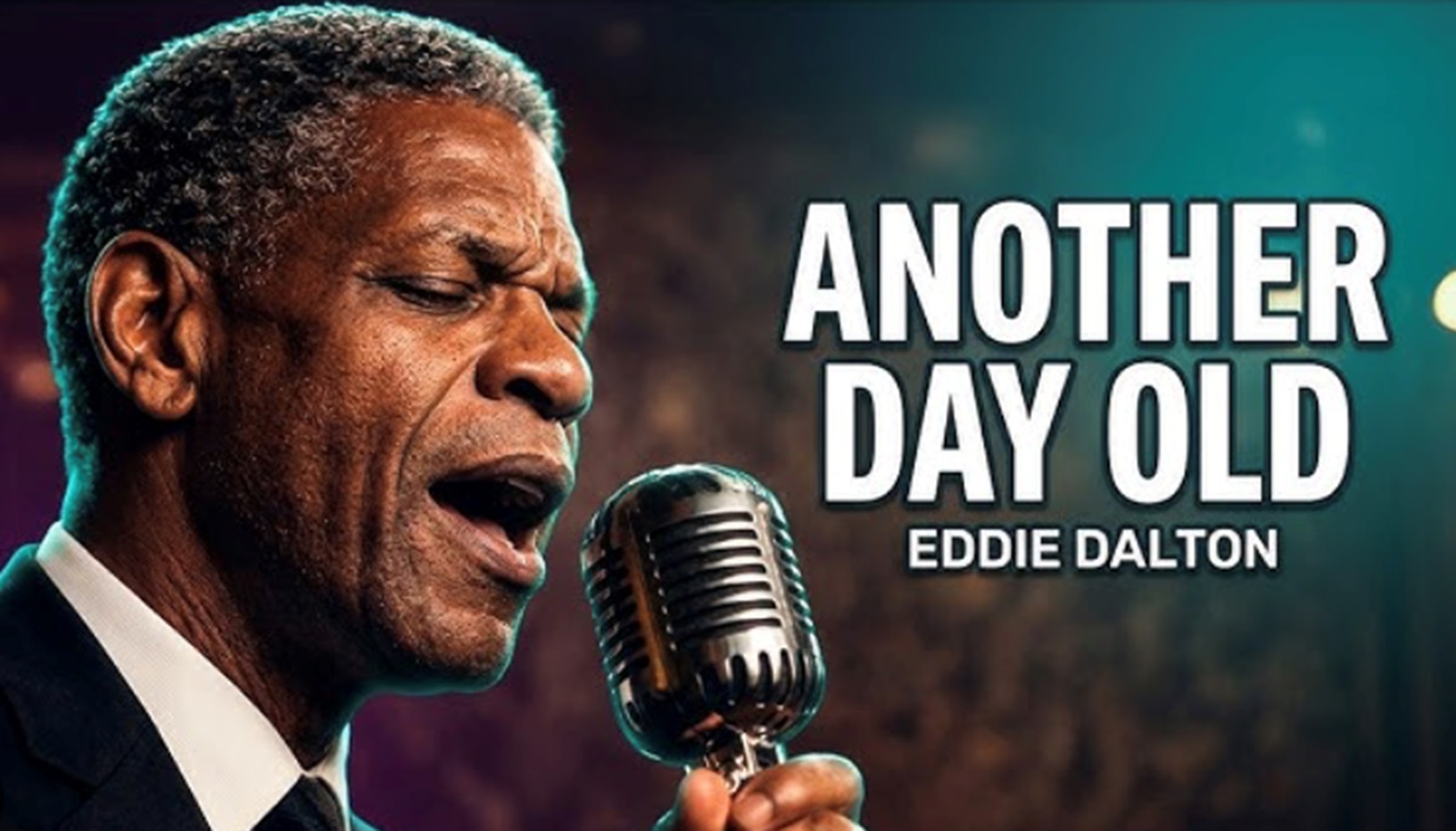
(Source: YouTube/Eddie Dalton)
And now the last piece of the cultural supply chain has the potential to shift as well: anyone can make it, anyone can distribute it – but will anyone be able to actually find it? Will discovery follow suit, or will the algorithm continue to gatekeep and concentrate output? In other words, does AI have the means to unlock the stranglehold of the big platforms and their algorithms?
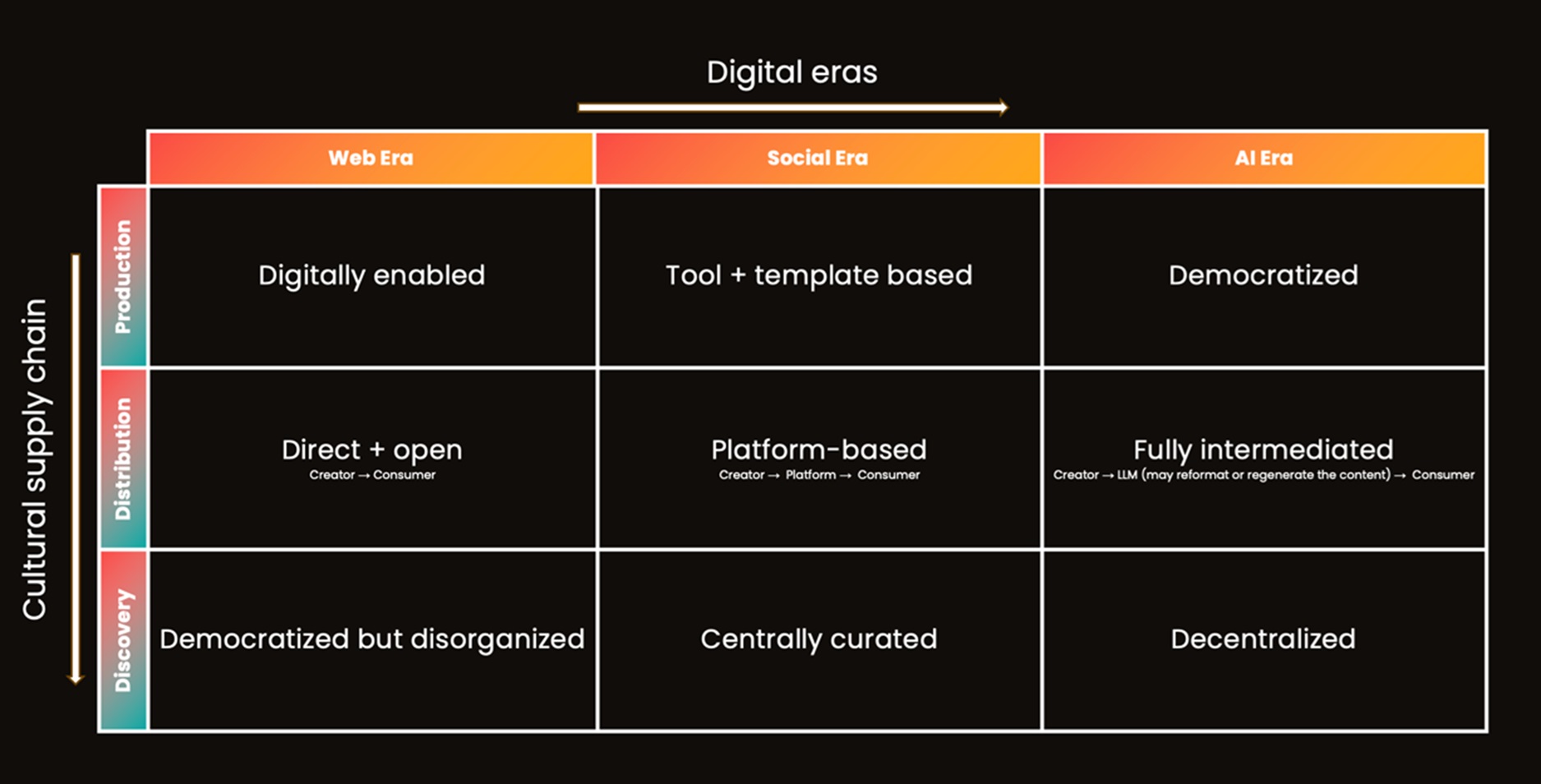
The era of agentic discovery and Long Tail 2.0
Certainly, the potential is there. Our interaction with AI means it may be time for the idea of the long tail to make a resurgence. As we search and scroll less, and converse more, so the output of our interactions should become more tailored and less mass.
The hope for a new era of cultural permeability lies in this idea of agentic discovery – in which content is not just surfaced to us, but sourced for us by agents trained around our preferences.
That sounds like a yes, then. So, what’s the caveat?
Well, in simple terms the model may become the new gatekeeper here. The LLM will now decide what I see in just the same way as the social algorithm has in the preceding period.
But it gets blurrier still.
Because of course what LLMs return to us is not always simply the original material itself. It may instead be content composed by the LLM, a cultural club sandwich with many layers created from source content using many different ingredients. In other words: I may not see your video, or hear your track, but instead experience part of it as a newly-concocted piece, a mixture of different source materials and components. This gets us into the world of generative distribution (‘my content becomes part of your content’) and reference economics (‘I get paid not by consumption of my content, but by the use of my content to compose other things;). Major music labels are already beginning to grasp this nettle, and platforms like Soundverse beginning to spring up around it.
And for brands? LLM may be the uber-influencer of the future
The way content gets discovered and delivered is of course foundational to how brands can operate in culture. And this world of discovery has the power to change fast. We may be moving to a model in which social is no longer the primary platform for digital interaction – and in which the only influencer who really counts is the LLM you dialogue with daily.
This implication goes beyond content. Commerce too will find its discovery chain reformatted by the new types of interaction we may have. The notion of zero click purchasing – where consumers buy from within the LLM without ever visiting your ecommerce store, and where your site may become simply a back-end vehicle for an agent to interact with – highlights the fact that as well as being the influencer of tomorrow, the LLM may also be the main salesperson.
Back to the future
And so, once again, we can dream of a cultural landscape in which discovery is more democratically-driven – in which gatekeepers and clout matter less than value, quality and imagination. That original notion – that digital may open up our worlds rather than close them off – comes back into play. The fact that the primary source for many LLMs is Reddit supports this notion – because Reddit is a community of real people, and so the models are being trained on what we are talking about and liking, right now, in the real world. But much is yet to play out, and only time will tell how the model entangles with our own interests, and whether it becomes an effective contributor to and curator of our cultural diets. What’s for sure is that the next phase in the shifting of our cultural landscape is happening now, yet to be shaped and in the hands of everyone creating - and using - these new tools. We are back in a pioneer phase, and the opportunity exists to once again build anew.
Sources: Rockonomics, Alan B. Krueger; Blockbusters, Anita Elberse; Alpha Data