By Jo Hayes, Barbarian, Executive Director of Strategy & Data
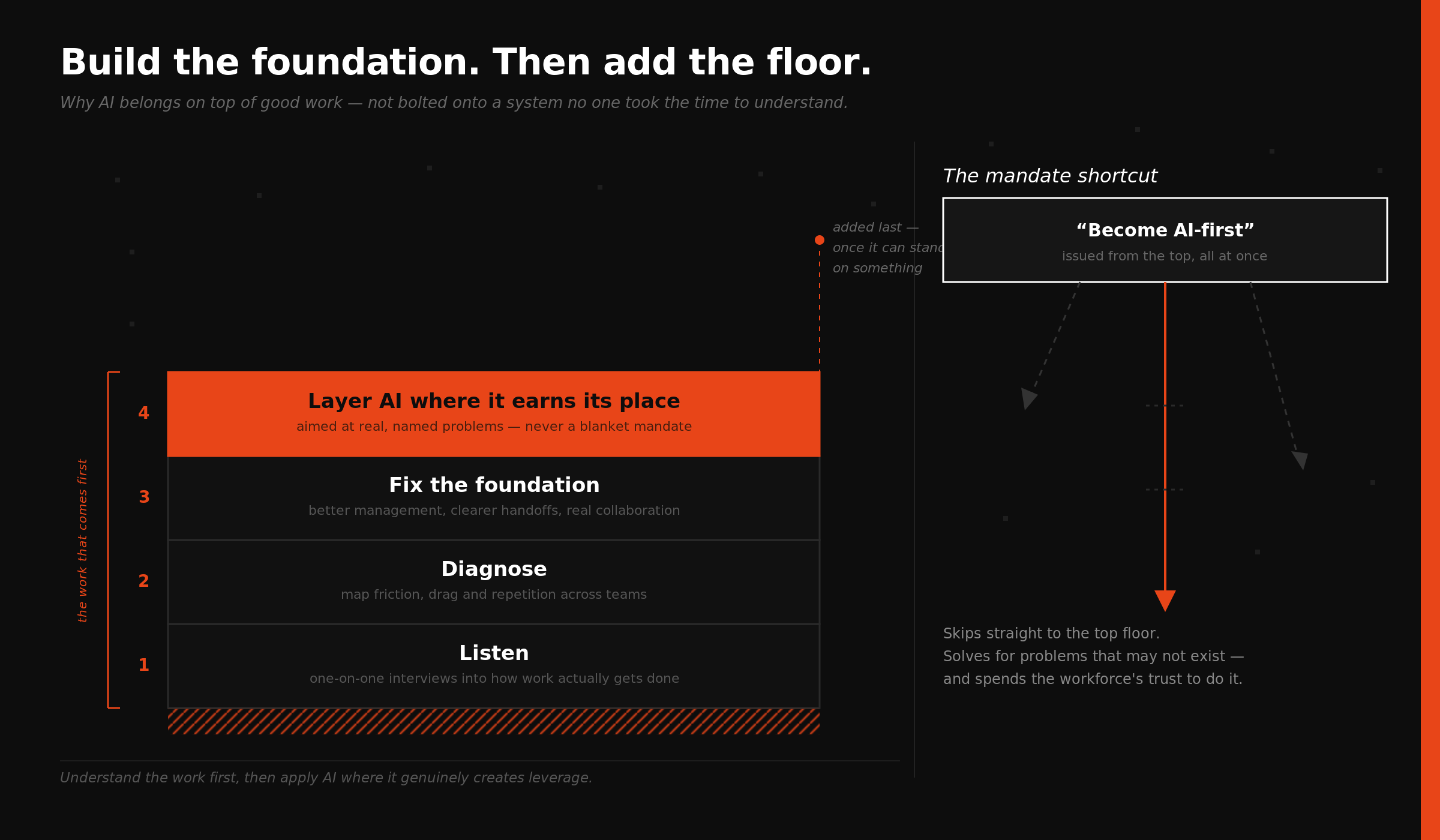
There's a particular kind of memo making its way through companies across all industries right now. You know the one – everyone pulls it up to show their friends at happy hour or brunch and rolls their eyes as they read it aloud. It announces that the organization is "transforming into an AI-first company," that every team will "integrate AI into their workflows," and that this is, “effective immediately, a priority”. The message ends there, though. No one tells you which workflows or what part of your work that actually involves. The mandate arrives like a pop-up thunderstorm and disappears just as fast, leaving only a mess in its wake.
While I disagree with the communication style, I understand the urgency behind it. AI skills have, for the first time, become the most difficult for employers to find globally, surpassing traditional IT and engineering, according to ManpowerGroup's most recent global talent report. Roughly 72% of employers say they're struggling to hire the talent they need. The capability gap is real, and the pressure leaders feel to close it is legitimate. But the response to that gap being top-down decrees to "use AI more" is, I'd argue, one of the sloppiest and least respectful things a leadership team can do to its own people.
I don't use those words lightly. I mean sloppy in the specific sense that a blanket mandate skips the actual work of understanding. And I mean disrespectful because it presumes that the problem is a team’s unwillingness to adopt a tool, rather than the possibility that no one has bothered to learn what their day actually looks like.
When AI is introduced through blunt force, it often creates resistance for reasons that have little to do with the technology. People do not push back simply because they are afraid of change. They push back when they feel unseen. They push back when the people asking for transformation do not seem to understand what their day actually requires. They push back when “efficiency” isn’t defined or understood, or when a tool is presented as a solution before anyone has bothered to understand the problem.
Here's what a mandate misses. Work is not a list of tasks waiting to be automated. It's a system of dependencies, handoffs, judgment calls, and accumulated context (much of it currently invisible).
This is the part that matters most to me, especially in a business like ours, where the entire premise of our work to be done is connecting with communities, generating emotion, and moving people to act. We ask our talent to bring genuine curiosity and care to understanding the audiences we serve. We study their behavior, their friction, their unspoken needs, before we ever propose a solution. There would be obvious hypocrisy in turning around and handing our own talent a context-free directive. We owe our workforce the same ambition and care we ask them to show the world.
That conviction is why, at Barbarian, we're not starting our AI effort with a tool rollout or a survey of who's using what AI tools. We're starting with conversations. We're running a structured listening sprint across the agency as one-on-one interviews designed to surface where people actually lose time, momentum, clarity, and energy. We ask people to walk us through their real work: what takes longer than anyone realizes, what requires the most judgment, where the same thinking gets repeated, where context is trapped in a single person's head. We are deliberately not asking, "have you tried using AI for that?" Because the moment you lead with the tool, you stop learning about the problem.
AI can create enormous leverage in those moments, but only if it is aimed at the right friction.
There is a meaningful difference between “How can AI make this faster?” and “What is making this harder than it needs to be?” The first question assumes the answer. The second question respects the work. That respect is an operational necessity.
What’s produced is a map: where friction lives, by discipline, by level, by how people work. That map tells us where to invest in process, in tooling, in training, and YES, in AI — where it genuinely creates acceleration rather than theater.
The irony of AI transformation is that it has to start with humanity. AI will absolutely change how we work. But if we want that change to be meaningful, we have to stop treating people as the barrier to adoption and start treating their experience as the data.
The mandate should be: understand the work deeply enough to make it better. AI can help us do that, but only if we are willing to listen first.